
AI Quick Summary
In the past three years, search has undergone more change than it did during the previous ten. You’ve likely spotted your organic traffic performance is off the charts, or maybe you’ve begun to see AI-generated summaries above the classic blue links.You’re likely seeing something that’s shaking up SEO, AI is happening in real time.
In AI-powered SEO, AI algorithms are leveraged for research, creation, optimization, and measurement of content to enhance its performance in AI-driven search engines. It’s not just a tactic that big technology companies use, it’s just a basic requirement for people to be found online.
This guide will help you understand what AI-powered SEO entails, how it’s reshaping each aspect of the Modern SEO process, which tools you should consider in 2026, and how to leverage it without losing control of your strategy. This article will provide you with a roadmap based on experience and practice that will help you run a startup, manage an in-house marketing team or advise clients as an SEO consultant.
What is AI-Powered SEO?
AI-powered SEO is the practice of applying artificial intelligence (AI) including machine learning, NLP and generative AI to support keyword research, content creation, technical audits, and performance analysis, with the goal of ranking, quality traffic well in both traditional search results and AI-generated answers.
Definition of AI SEO
AI-powered SEO is the practice of applying artificial intelligence including machine learning, NLP and generative AI to support keyword research, content creation, technical audits, and performance analysis, with the goal of ranking well in both traditional search results and AI-generated answers.
Rather than replacing SEO strategy, AI acts as an accelerant. It processes enormous datasets, spots patterns humans would take weeks to find, and automates repetitive tasks so strategists can focus on judgement calls that still require a human brain.
How AI is Changing Traditional SEO
Basically Traditional SEO is heavily reliable on manual research, static rules and a fair amount of guesswork. You’d pick a keyword, write around it, build links, and wait to see what happened.
AI SEO flips that model. Instead of reacting to ranking changes after the fact, teams can now:
- Predict which topics are likely to gain search demand before they peak
- Test multiple content angles against real search intent data
- Identify technical issues automatically, rather than during periodic manual audits
- Adjust content in near real-time based on performance signals
This shift from reactive to proactive optimisation is arguably the single biggest change AI has brought to the discipline.
Why AI Matters for Modern Search Engines
Regular old SEO was really based on a lot of manual research, static rules and some guesswork. You would choose a keyword, you’d write a little bit of it, you’d create links, and you’d wait and see what happened.
Experiment with different angles of content relative to customers search intent. Automatically detect technical problems, not in a scheduled audit Fine-tune content in real time, according to performance data. This transformation from reactive to proactive optimisation is perhaps the most significant change in the field that AI has introduced.
If your SEO method is still one that is simply trying to match strings, then you are focusing on a search engine that no longer exists in that format. The ability to comprehend content entities, context and relationships between concepts is now a key aspect of visibility, and understanding how a content entity is interpreted by AI is a key part of that.
Key Difference Between AI SEO vs Traditional SEO
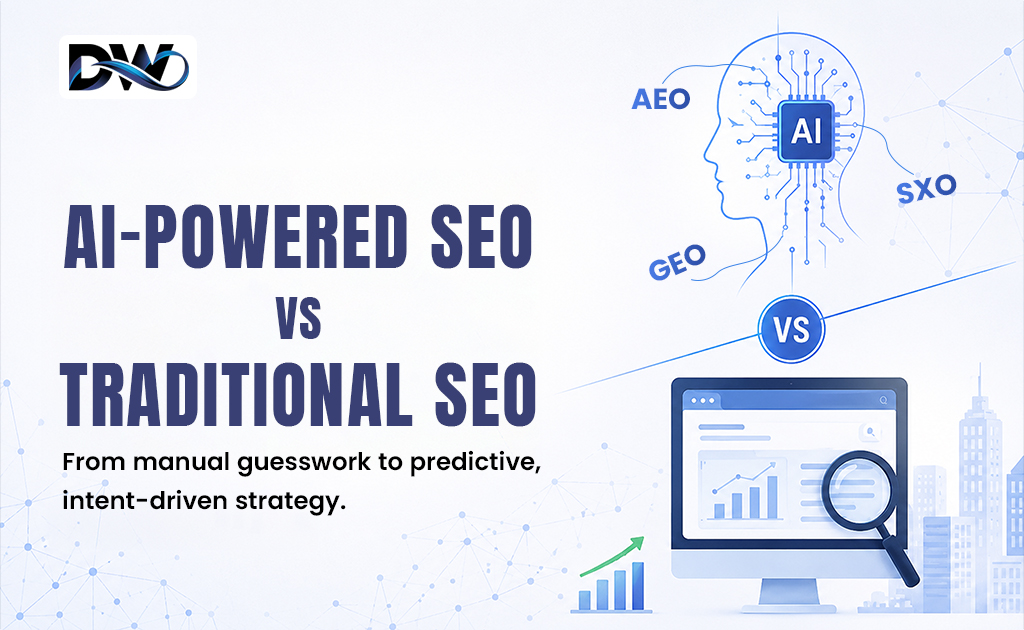
Understanding the practical differences helps clarify where AI genuinely adds value and where traditional principles still apply.
Neither approach fully replaces the other. The strongest strategies in 2026 blend AI’s speed and scale with traditional SEO’s strategic and creative judgement.
Best SEO Services in Greater Noida: AI-Powered SEO That Drives Real Growth
As an AI-powered SEO agency, we go beyond traditional keyword optimization. We structure your content and website so it performs well across Google’s AI Overviews, AI search engines, and voice assistants, a strategy often called AEO (Answer Engine Optimization) and GEO (Generative Engine Optimization). This ensures your business stays visible as search behavior shifts toward AI-driven answers.
If you’re searching for the best SEO services in Greater Noida, you already know that generic, one-size-fits-all SEO doesn’t work anymore. Search engines have changed. Buyers have changed. And the way people discover businesses through Local SEO Google, AI search assistants, and Maps has changed too.
Digital Works Solution is a Greater Noida-based SEO company built for this new era of search. We combine proven SEO fundamentals with AI-powered SEO strategy to help local and growing businesses in Noida and Greater Noida rank higher, attract qualified traffic, and generate consistent leads.
5 Factor How AI is Transforming Search Engine Optimization
AI’s influence touches nearly every stage of the SEO workflow. Here’s where the impact is most visible and most actionable.
1. Smarter Keyword Research
AI tools not only give you search volume and difficulty scores but they also indicate which keywords are relevant for your content. AI will be able to understand the intent of searchers, group semantically similar search queries together, and bring up questions that are frequently asked by users and correspond directly with the content in the SERP.
For instance, when I manually cluster ‘best running shoes’ and ‘top running shoes 2026′ and ‘running shoe reviews’, I’m spending hours on a spreadsheet – AI can do this automatically, and can detect relationships a human researcher might overlook.
2. AI-Based Content Optimization
Content optimization tools now rate first page content against draft content for topical completeness and readability and semantic relevance, rather than keyword density. This allows the writer to write extensively about a topic instead of repeating the same phrase to meet an outdated algorithm.
When this is done properly, it will result in fewer thin articles, and more truly comprehensive resources that can provide the answers to a reader’s entire question.
3. Predictive SEO Analysis
Predictive models can predict the performance of a page in the event that they’ve got a historical pattern of ranking, seasonal trends, and competitor movement. This does not mean a guarantee of results but it can help a team figure out what will offer the greatest return on the investment in resources before they invest.
4. Automated Technical SEO
Once a day an audit of sites can be done in the background, in real time. While a quarterly audit can uncover broken links, duplicate metadata, slow loading pages, and crawl budget problems, AI-powered crawlers can identify these issues as they occur.
5. Understand how to leverage AI for user experience (UX).
Google has stated that page experience, which includes load speed, mobile usability and interactivity, will play a role in the assessment of content. Heatmaps, scroll depth and user engagement data can now be analysed by AI tools and recommended improvements that can keep users on the page longer, indicating relevance and quality to search engines.
4 AI Technologies That Behind Modern SEO
To use AI SEO tools effectively, it helps to understand the underlying technologies doing the work.
1. Machine Learnings
With machine learning, systems can detect patterns in data to determine what type of media content to serve for different query types, and grow more accurate over time by learning from new situations without having to be explicitly programmed for them.
2. Natural Language Processing (NLP)
NLP allows search engines and search tools to better interpret grammar, context and word relationships – not a sentence as a set of disassociated words. This is why it’s becoming more important to write naturally, with well-structured, complete sentences, instead of simply adding keywords in the right places.
3. Generative AI
With Generative AI models, such as Large Language Models, one can create outlines, write meta descriptions, summarise research and even first draft content. When used with human oversight and intervention, generative AI can boost productivity without compromising quality.
4. Large Language Models (LLMs)
From AI Overviews to Chatbots and Content Assistants, LLM are driving it all. This is one of the reasons why detailed, well-structured content outranks content that is broken up into small chunks of keywords.
The AI Ranking Systems developed by Google
Google’s search algorithm has been transformed into a multilayered system of AI problems where each layer addresses a distinct problem:
1. RankBrain
Rank Brain assists Google with understanding the intent of a query, not just the exact words used, in cases where the query has no exact meaning.
2. BERT
It enhances the comprehension of context and the association between words within a sentence, especially for conversational or long-tail search queries.
3. MUM (Multitask Unified Model)
It handles multiple parts of information in text, image and many languages at once, thereby allowing more complex, multi-part answers.
4. AI Overviews
It creates AI-generated summary directly in the search results from various sources, answering a query without requiring a click. The way these systems work is not academic; it will have a direct impact on the way you need to design and develop content for these systems.
Benefits of AI-Powered SEO
When implemented thoughtfully, AI-powered SEO delivers measurable advantages across the funnel.
1. Faster keyword research: Clustering and intent analysis that once took days now takes minutes.
2. Better content quality: semantic scoring encourages comprehensive coverage rather than keyword padding.
3. Improved search intent matching: AI helps align content with what searchers actually want, not just what they typed.
4. SEO automation: Routine technical checks and reporting run continuously, freeing up strategic time.
5. Higher rankings: content that genuinely satisfies intent tends to perform better and more sustainably.
6. Better UX: Data-driven UX recommendations keep visitors engaged longer.
7. Higher conversions: content aligned with real intent naturally converts better than content built around guesswork.
None of these benefits are automatic, though. They depend on how the tools are used, which is why strategy still matters more than software.
5 Common Challenges of AI SEO
AI SEO isn’t without friction. Understanding the pitfalls helps you avoid them.
1. AI hallucinations:
AI models can generate confident-sounding but incorrect information. Overcome this by fact-checking every claim, statistic and quote before publishing, and by avoiding reliance on AI for niche or highly technical claims without verification.
2. Duplicate content:
Multiple sites using similar AI prompts can produce strikingly similar output. Counter this by injecting original research, first-hand experience and a distinct brand voice into every draft.
3. Over-automation
Publishing AI content without editing at scale erodes quality and trust. Set a firm rule that no AI-assisted content goes live without human review.
4. Thin content:
AI can produce technically correct but shallow articles. Combat this by requiring genuine depth, examples and practical takeaways in every piece, not just surface-level summaries.
5. Google’s Helpful Content standards
Google actively devalues content created primarily to manipulate rankings rather than help readers. The safest strategy is to always write for the reader first and let SEO structure follow naturally.
AI SEO Trends Shaping 2026 and Beyond
Several trends are actively reshaping how visibility is earned in search.
1. AI Overviews are increasingly answering queries directly on the results page, changing how and when users click through to websites.
2. Zero-click searches continue to rise, meaning brand visibility and citation matter as much as raw traffic in some cases.
3. Voice search is pushing content towards natural, conversational phrasing that mirrors how people actually speak.
4. Visual search allows users to search using images rather than text, requiring strong image optimisation and structured data.
5. Personalised search results are becoming more tailored to individual user history and context, making broad-match strategies less reliable.
6. Multimodal search combines text, image, voice and video in a single query, rewarding content that’s optimised across formats.
7. Agentic AI AI systems that can take multi-step actions on a user’s behalf, such as comparing products or booking services is beginning to influence how content needs to be structured for machine readability, not just human readers.
Businesses that adapt early to these shifts will have a meaningful head start over competitors still optimising purely for traditional blue-link rankings.
How Businesses Can Prepare for AI-Powered Search
Preparing for this shift doesn’t require an overnight overhaul — it requires deliberate, prioritised action.
1. Audit your current content for topical depth, accuracy and genuine helpfulness, not just keyword coverage.
2. Invest in structured data so search engines and AI systems can clearly understand your content’s context and entities.
3. Build topical authority by covering subjects comprehensively across clusters of related content, rather than isolated one-off posts.
4. Strengthen EEAT signals with author bios, credentials, case studies and transparent sourcing.
5. Monitor AI Overview appearances for your target queries to understand how your brand is (or isn’t) being cited.
6.Train your team on responsible AI tool use, including fact-checking workflows and editorial standards.
7. Diversify visibility channels, since zero-click search means brand presence beyond your own site on review platforms, forums and industry publications increasingly matters.
For businesses without in-house SEO expertise, working with a professional SEO service can help translate these priorities into a structured, measurable strategy rather than piecemeal experimentation.
Conclusion
AI-Powered SEO is not just a fleeting trend; it’s a fundamental change in the way search engines process, rank, and display information. Whether it’s intelligent keyword research, predictive analytics, or automated technical audits, AI has revolutionized the way SEO works, making it faster, more accurate, and more scalable than ever before.
Speed and scale can only be important as long as there is a good strategy. The companies that will succeed in this new digital world are those that are able to use Artificial Intelligence as a potent tool to complement human intelligence, creativity, and judgment. With the rise of AI-powered search, EEAT, helpfulness, and search intent will be just as critical as ever. EEAT, helpfulness and search intent will be just as important in an AI-powered search context as they have always been if not more.
Frequently Asked Questions
Find answers to common questions about AI-Powered SEO