
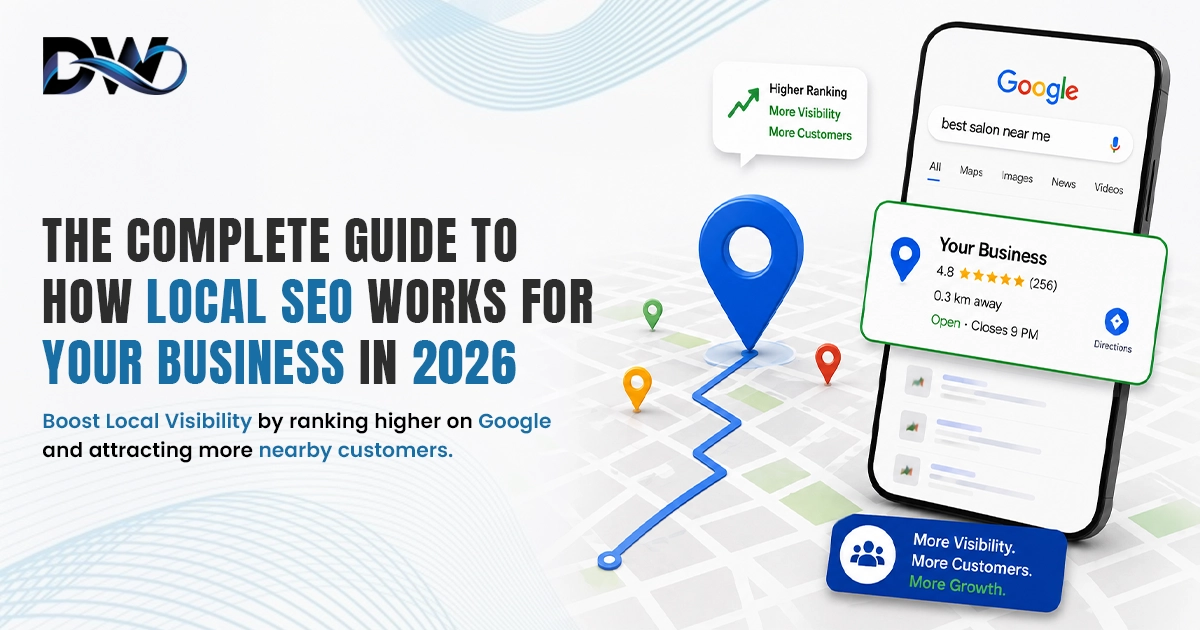
Millions of people search for businesses near them every day – a dentist, a plumber, a coffee shop. They type “near me” or just a city and Google instantly connects them with relevant local results.
That connection is powered by Local SEO, the practice that decides which businesses appear when someone searches with local intent. Understanding how Local search optimization works is no longer optional for any business that serves customers in a certain area. This is the foundation of modern local visibility.
What Is Local SEO?
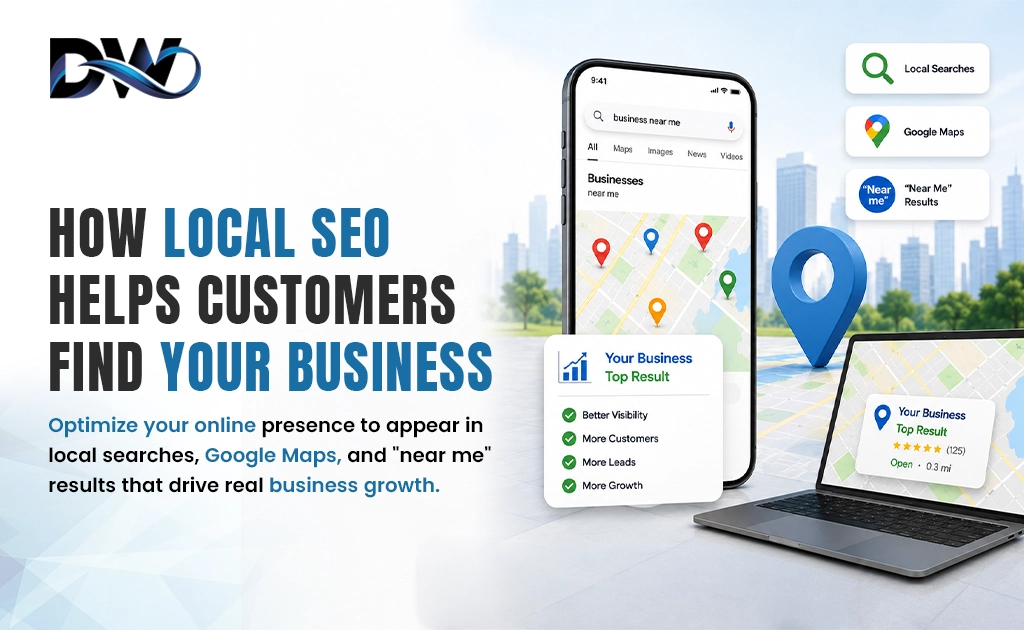
Local SEO (Search Engine Optimization) is how search engines, mainly Google, find and show local businesses when people search for things nearby. It decides which businesses appear on Google Maps, in the Local Pack, and in local search results when someone wants a product or service in their area.
Unlike general digital marketing, local search optimisation focuses entirely on location. It helps Google answer the question, “Which business is best for this person right now, in this place?”
Want to build a stronger local presence? Read our complete guide to Local SEO Strategy.
How Local SEO Works in 2026
1. Understanding Google’s Local Search Algorithm
Google’s hyperlocal search algorithm is a separate but related layer of its overall ranking system. It’s not just about finding relevant pages, it’s about finding the most appropriate business for an immediate, location-specific need.
To do this, Google maintains an index of business entities. Not just web pages. It combines an understanding of each business from dozens of data sources and cross-references that info to determine which businesses it can confidently recommend.
2. The Role of Relevance
Relevance is the degree to which a business matches what someone is searching for. Google considers the type of business, the language used on the business’ digital footprint and the kind of services the business provides.
If you search for “family solicitor,” you should find solicitors who do family law, not general legal practices that have no family law signals. Relevance is about contextual fit, not just keyword matching.
3. The Role of Distance
Distance measures how close the business is to the user who is searching or the location the user specified. All else being equal, businesses that are closer to the searcher are more likely to rank higher in local results.
However, distance is never the sole factor. A relevant and prominent business that is a little further away will often outrank a closer competitor that provides weaker signals to Google.
4. The Role of Prominence
This is a measure of how well-known and trusted a business is both online and offline. Businesses with strong reputations, high volumes of reviews, consistent mentions across the web and authoritative websites tend to achieve greater hyperlocal search visibility.
Google sees prominence as a trust signal. The more a business gets talked about, linked to and engaged with, the more likely it is to be a reliable recommendation.
What Happens When Someone Searches for a Local Business?
1. Search Query Analysis
As soon as a user enters a query, Google instantly analyzes the intent behind that query. Google will enter hyperlocal search mode if a search contains location terms, phrases such as “near me” or language specific to a service. Even if you don’t include any location words, Google can infer local intent based on your device location and your search history.
2. Google Maps Integration
Google Search is deeply integrated with Google Maps. When a search has local intent, Google pulls the data directly from its business index — the same data that powers Maps to display on the Search results page. This means that a business’ presence on Maps impacts its visibility on Search.
3. Local Pack Results
The Local Pack (also called the Map Pack) is the big cluster of three business listings that shows up at or near the top of local search results, along with a map. It is very visible and gets a big chunk of the user clicks.
The Local Pack shows a business name, category, rating, location and other important information, giving users enough information to make a decision without visiting a website.
4. Organic Local Results
Under the Local Pack you will also see classic organic listings, often filtered and localised to the user’s area. These are not business profile listings but web pages (usually location-specific pages on business websites or local directories).
Local Pack and organic local are both important. A lot of users skip the Pack and go straight to organic results, especially for decisions that require a lot of research.
Ready to improve your local rankings? Explore our proven Local SEO Strategy framework.
Key Elements That Influence Local Rankings
1. NAP Consistency (Name, Address and Phone Number)
NAP (Name, Address, and Phone Number) consistency is a crucial Local SEO ranking factor that helps Google verify your business information across the web. Maintaining the same business name, address, and phone number on your website, Google Business Profile, local directories, and social media platforms builds trust and improves local search visibility. Key benefits include:
- Improves Google’s trust by confirming your business details are accurate and consistent.
- Boosts Local Pack and Google Maps rankings by strengthening local ranking signals.
- Enhances local business reach by making it easier for nearby customers to find and contact you.
- Reduces customer confusion by ensuring the same contact information appears everywhere online.
- Increases the chances of higher local rankings as consistent NAP signals improve your business’s credibility and authority in local search results.
2. Google Business Profile Signals
A Google Business Profile (GBP) is the official record of a business on Google. It has a name, address, phone number, category, hours and more. This profile is among the most direct inputs into Google’s understanding of what a business is, where it is, and who it serves.
“An incomplete or inaccurate profile equals uncertainty for Google, and uncertainty usually equals lower rankings.
3. Website Authority Signals
A business’s website offers trust, relevance and authority signals for local rankings. Google looks at how well structured and credible the site is, and how consistently it represents what the business says it does. Links to your site from other reputable sites will reinforce this authority.
4. Online Reviews & Reputation
Reviews are some of the best signals of real world business quality. Google takes into account the number of reviews, the average rating, the recency of the reviews and the content of the reviews. A business that has a consistent and reliable track record of reviews will be trusted by Google and also by customers.
5. Local Citations
A citation is any online reference to a business’s name, address and phone number. All of this information should be consistent across directories, data aggregators and other platforms, which further builds Google’s confidence in the legitimacy and location of the business. Even small inconsistencies can put a doubt in the algorithm.
6. User Engagement Signals
In local results, Google considers interactions with a business, such as clicking through to a website, requesting directions, making calls or spending time on a profile as a relevance signal. So if users continue to choose your business over the competition, it’s clear there’s a real demand for it.
7. High-Quality Images
Adding high-quality, up-to-date images to your Google Business Profile helps attract more customers and improves engagement. Regularly updated photos build trust, showcase your business, and signal to Google that your profile is active, contributing to better local search visibility.
Benefits of Local SEO for Businesses
1. Increased Local Visibility
Local Search optimisation puts a business in front of people who are actively looking for what it has to offer in the area it serves. This is exposure at the exact time when a purchase decision is made.
2. Higher Quality Leads
A user searching for “emergency boiler repair Manchester” has a high purchase intent. Hyperlocal search results bring businesses together with ready-to-act customers, not just browsers.
3. More Calls and Enquiries
Phone numbers and click-to-call are shown prominently on Local Pack listings. Getting into these results means inbound calls and enquiries go up straight away without any extra ad spend.
4. Improved Conversion Rates
Local search attracts high-intent users at the point of need, so conversion rates from local search traffic tend to be higher than broad organic or paid traffic.
Want to maximize your online visibility? Read our guide on choosing the right digital marketing agency.
Local SEO Trends Shaping 2026
1. AI-Powered Search Results
Google’s use of AI-generated summaries in search results is changing how people engage with local information. AI-generated overviews now highlight concise answers before traditional results, which means businesses need to maintain clear and consistent online presence to be included in these overviews.
2. Voice Search Growth
Conversational queries like “who is the best plumber near me?” are becoming more common as voice search continues to grow via smart speakers and mobile assistants. These are local queries and businesses need to have the information structured and clear for Google to interpret.
3. Hyperlocal Targeting
Google is improving at differentiating between various neighbourhoods in a city. Local search results can vary greatly in the short distances in 2026, so local relevance is more important than ever.
4. Mobile-First Local Searches
Most local searches start on mobile. Google’s mobile-first indexing ties a business’s performance on mobile directly to how it’s evaluated and ranked in local results.
5. Visual Search & Maps Integration
Adding local discovery with Google Lens and visual search features. “Maps is evolving into a discovery platform in its own right, and we’re making it easier for users to search for businesses with images.
For more insights into improving your local visibility, refer to Google’s official guide on improving your local ranking.
How Long Does Local SEO Take to Show Results?
It’s difficult to give a timeframe for local search results as it depends heavily on the competitiveness of the marketplace, how authoritative a business’s online presence already is and how consistent signals are on the web.
If the market is less competitive, you might see some big changes in your local rankings in only a few months. In competitive urban markets with current competition it takes a lot longer.
Factors that influence the pace of results include the age and authority of the business’s website, the volume and quality of existing reviews, citation consistency, and how well-established competitors are in the same area. If you’re getting into Local search optimisation, plan for the long term rather than for a short-term campaign. And SEO doesnt guarantee long term success only.
Local search optimization is the process of connecting local businesses with local searchers. It does so by running a evaluation of relevance, distance and prominence based on a business’s Google Business Profile, website, citations, reviews and user engagement signals.
Have questions about improving your local rankings? Get in touch with our team and let’s discuss your business goals.
How Digital Works Solution Can Help Improve Your Local SEO Rankings
At Digital Works Solution, we help businesses strengthen their local online presence through tailored Local SEO strategies. From optimizing your Google Business Profile and ensuring NAP consistency to managing local citations, reviews, and location-focused content, our experts implement proven techniques that improve local rankings, increase visibility on Google Maps, and drive more qualified local leads to your business.
Frequently Asked Questions
What is local SEO?
Local search optimisation puts businesses in front of local searches by ranking them on Google Maps and local results based on relevance, distance and prominence.
What are the main local ranking factors?
Google uses Business Profile signals, website authority, reviews, citations and user engagement to confirm a business’s identity and quality.
Is local SEO different from SEO?
Yes. Traditional SEO is based on generic search queries whereas Local search optimisation is based on location-based search queries.
How long does local SEO take?
The results depend on the competition, the less competitive the market, the faster the results.
Does every business need local SEO?
Local search visibility is a benefit when businesses target a specific geographic area.
Can local SEO help service-based businesses?
Yes, local search visibility can be a huge asset for service-based businesses.