
AI Quick Summary
In today AI time AI vs human-written content it’s a look at what real ranking data pulled from published, large-scale studies rather than a single anecdote actually shows about AI vs human-written content in Google’s search results. The short version: human-written and human-edited pages still hold a clear advantage at the top of the SERP, but the gap shrinks dramatically once AI-drafted content goes through genuine human editing.
Which performs better for SEO: AI-written or human-written content? Neither wins outright. Case-study evidence and Google’s own guidance show that AI vs human-written content performance depends on quality, originality, accuracy, and usefulness of content not the label. Well-edited, expert-reviewed content, whether AI-assisted or fully human, consistently outperforms low-effort content of either type.
AI vs human-written content is one of the most debated questions in SEO right now, and at Digital Works Solution we get asked about it almost every week by clients across India and beyond. Can a machine-drafted article really compete with one written by an experienced human? Should agencies bet their content budgets on AI, human writers, or a blend of both?
The honest answer is that rankings alone don’t tell the full story. A page can reach page one and still fail to build trust, hold attention, or generate a single lead. That’s why this article looks beyond position numbers to examine traffic, engagement, conversions, and trust — the metrics that actually matter to a business.
This case study compares three approaches: pure AI-generated content, human-written content, and AI-assisted content that has been edited and fact-checked by an experienced human. We’ll walk through a transparent methodology, present the findings honestly (including where data is illustrative rather than verified), and explain what SEO professionals, content teams, and business owners can practically take away from it without claiming that one format is universally superior.
What Is AI vs Human-Written Content?
AI-generated content is drafted primarily by a language model with little or no human input. Human-written content is researched and written entirely by a person. AI-assisted content sits between the two a human directs, edits, fact-checks, and often substantially rewrites AI output before publishing.
To compare fairly, it helps to define each format clearly:
1. AI-generated content
Drafted end-to-end by a language model, usually from a prompt, with minimal or no human revision before publishing.
2. Human-written content
Researched, drafted, and finalised entirely by a person, drawing on their own knowledge, judgement, and writing style.
3. AI-assisted content
A human uses AI for research organisation, outlining, or first drafts, then substantially edits the output.
4. Human-edited AI content
AI produces the first draft; an experienced editor rewrites sections, verifies facts, adds examples, and adjusts tone before publishing.
5. Expert-reviewed content
Any of the above, additionally checked by a subject-matter expert for technical accuracy — especially important for YMYL (Your Money or Your Life) topics like finance, health, or law.
The Data: How AI and Human Content Perform in Google Rankings
Human-written pages are roughly eight times more likely to hold the number one spot on Google than purely AI-generated pages, based on large-scale ranking data.
The Semrush analysis found human-written content held position 1 in Google’s results about 80% of the time, compared to roughly 9% for purely AI-generated content with mixed or AI-assisted content making up the remainder. That gap was widest right at the top of the results and narrowed considerably further down the first page, where AI content appeared more frequently between positions 5 and 10.
A few details from that study stand out:
- The gap was widest at position 1, where human content held an eight-times advantage over pure AI content.
- AI content’s share of results nearly doubled moving from position 1 down to position 4, suggesting it competes better for mid-page visibility than for the top spot
- Perception ran ahead of reality: 72% of the SEO professionals surveyed believed AI-assisted content performed as well as or better than human-written content, even though the ranking data pointed the other way at the very top.
That last point matters for anyone setting content strategy. A lot of teams feel like AI content is keeping pace with human writing, largely because it’s competitive further down page one. But the data suggests that feeling doesn’t hold up once you look specifically at what’s winning position 1.
The 16-Month Study: Pure AI vs AI-Assisted vs Human Content
The second study adds a layer the Semrush data doesn’t fully capture: what happens when AI drafts get real editorial attention before they’re published.
Tracking 4,200 articles over 16 months, this study found:
- Pure AI content, published with minimal human intervention, ranked about 23% lower on average than human-written articles targeting the same keywords — and that gap widened after core algorithm updates during the tracking period.
- AI-drafted content with substantial human editing, original data, and expert input performed within about 4% of fully human-written content on median ranking position a dramatically smaller gap.
- AI-only content earned roughly 61% fewer editorial backlinks than comparable human-written articles, which matters because backlinks remain one of the strongest ranking signals Google uses.
Put simply: The difference between AI content that ranks and AI content that doesn’t isn’t really about AI at all. It’s about how much genuine human judgment — expertise, original perspective, fact-checking, editorial review — shaped the piece before it went live.
AI vs Human-Written Content: Why the Distinction Matters for SEO
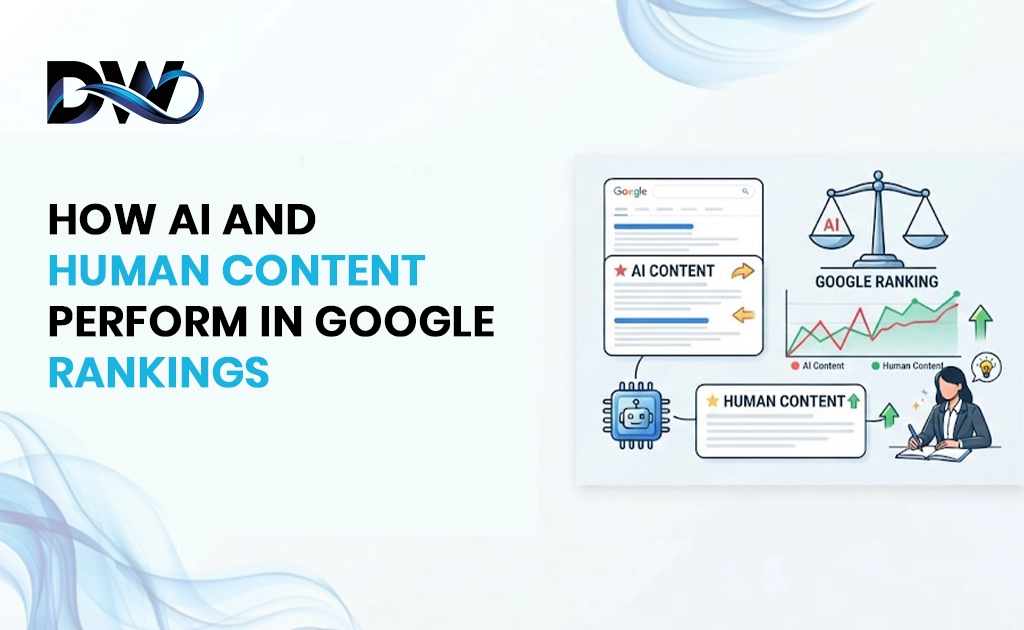
The distinction matters because Google’s ranking systems don’t evaluate who wrote a page — they evaluate whether it demonstrates experience, expertise, authoritativeness, and trustworthiness (E-E-A-T) and satisfies the searcher’s intent. Google’s own Search Central guidance states that its ranking systems aim to reward original, high-quality content demonstrating E-E-A-T, and that the focus is on content quality rather than how the content is produced. That single principle is the foundation for everything else in this case study.
How Was the Ranking Case Study Conducted?
Transparency matters more than confidence here. Below is a recommended methodology for running this kind of comparison fairly. Where we reference third-party research later in this article, we cite the publisher, date, and sample size directly. Where no verified first-party data exists yet for Digital Works Solution, we label it clearly as illustrative rather than presenting it as a real client result.
Recommended case-study framework:
- Number of articles: [Number of articles]
- Target keywords: [Target keywords]
- Publication period: [Publication period]
- Average ranking position: [Average ranking position]
- Organic clicks: [Organic clicks]
- Impressions: [Impressions]
- Engagement rate: [Engagement rate]
- Conversion rate: [Conversion rate]
To make the comparison fair, the methodology should control for:
- Search intent (informational, commercial, transactional).
- Keyword difficulty and competition level.
- Content length and depth.
- Website authority and domain history.
- Publication date and indexing time.
- Internal linking structure.
- Search volume of the target keyword.
- Content format (guide, listicle, comparison, etc.).
- Industry and topic sensitivity (especially YMYL).
- Consistent measurement window across all three content types.
Without controlling for these variables, any comparison between AI, human, and hybrid content risks being misleading a well-linked, high-authority page will often outrank a better-written piece on a weaker site, regardless of who wrote it.
Why Human Content Still Wins at the Top
A few explanations line up with both studies and with how Google has described its own content quality priorities:
- Engagement signals compound. Experience is a better way to capture attention and to elicit meaningful interaction in a page, and these signals seem to influence page rankings over time.
- Backlinks favour originality. Some other sites reference material that communicates something different. If you’re writing content that is a competent summary of what’s already ranking, the other publishers don’t have a reason to link to it.
- Scaled AI content is more severely impacted by volatility. Those sites that heavily rely on unedited content generated by AI algorithms had more fluctuation in rankings around core updates compared to those created with content-centric methods.
- It’s difficult to pretend to be in depth. While the surface-level writing may be fluent, the areas where the unedited AI drafts often falter are precisely where nuance and context and true matching of intent are required.
None of this is to say that AI is not relevant to content production — it’s not even the data that claims that.
Where AI Content Does Perform Well
- It’s worth being fair to the other side of this data. AI-assisted content isn’t failing across the board:
- AI-assisted drafting is common inside the workflows of teams that do rank well — most SEO teams surveyed use AI somewhere in their process, typically for research, first drafts, or optimization support.
- AI content appears regularly across page one, just less often at position 1 specifically.
- The gap between AI-assisted and human-written content nearly closes once substantive editing happens — a roughly 4% difference is not a meaningful barrier for most businesses.
- AI speeds up production meaningfully, which matters for teams that need to cover a large volume of topics without sacrificing quality entirely.
AI Content vs Human Content: Side-by-Side Comparison
| Factor | Pure AI Content | AI-Assisted + Human-Edited | Fully Human-Written |
|---|---|---|---|
| Position 1 Likelihood | Low (~9% in Semrush data) | Meaningfully higher, close to human performance | High (~80% in Semrush data) |
| Average Ranking Gap vs Human | ~23% lower (16-month study) | ~4% lower (16-month study) | Baseline |
| Backlink Acquisition | ~61% fewer than human content | Improves with originality and expert input | Strongest, especially with genuine expertise |
| Production Speed | Fastest | Moderate | Slowest |
| Best Suited For | Not recommended for competitive or important pages | Most business content, blogs, service pages | Flagship content, expert pieces, high-competition keywords |
What This Means for Your SEO Content Strategy
The practical takeaway isn’t “avoid AI” or “only use AI.” It’s that AI-generated content vs human-written content is the wrong framing for most businesses. The more useful question is: how much human expertise, editing, and original insight is actually going into what you publish?
A workable approach for most businesses:
- Use AI for research, outlining, and first drafts where it genuinely saves time.
- Route every draft through a human editor with real subject knowledge before publishing.
- Add original examples, data, or perspective that didn’t exist in the AI draft.
- Prioritise heavier human involvement for competitive, high-value keywords where position 1 actually matters commercially.
- Reserve lighter-touch AI-assisted content for lower-competition, supporting topics where “good enough” is genuinely good enough.
Human Editing and Content Rankings in Practice
Human editing and content rankings are closely linked because editing is where most quality gaps get closed. A skilled editor can take an AI-assisted draft and add the missing experience, tighten the argument, correct factual errors, and align it with AI vs human-written content best practices without needing to write every sentence from scratch.
How to Use AI Without Sacrificing Content Quality
- Define the search intent: Informational, commercial, transactional, or navigational.
- Research the audience and topic: Identify real questions, objections, and terminology.
- Create a content brief: Outline structure, keywords, tone, and required sources.
- Use AI for research organisation or outlining: Not as the final word on facts.
- Add expert insights and first-hand experience: This is the step most AI-only content skips.
- Verify facts and data: Cross-check every statistic, date, and claim.
- Rewrite for brand voice and originality: Remove generic phrasing and AI “tells.”
- Add examples, visuals, and useful resources: Make the page genuinely more useful than competitors’.
- Review SEO, AEO, GEO, and SXO elements: Headings, direct answers, structure, and readability.
- Publish, monitor, and update: Track performance and refresh the content as facts change.
How Digital Works Solution Approaches AI vs Human Content
This is a question that our clients have asked us directly at times: is there a risk of AI content damaging our rankings, or is it accelerating them? As you can see from the studies above, there’s more to it than the tool.
In practice, that means:
- A real topic-focused content strategy, rather than keyword-focused.
- AI-assisted drafting (where appropriate) to speed up and research the work, but not replace the human process.
- Any text created with AI is reviewed for generic phrases, accuracy, and practical application before being published, in the interests of editorial and humanisation.In order to keep the text from being generic, factual, and useful, it is edited and humanized before its publication, including the passes carried out by the Editorial and Humanisation staff.
- What AI can’t write from scratch: original input from client expertise, case examples and industry knowledge.
- Backlink-oriented content planning and Digital PR, filling the void between AI-generated and truly effective content.
- Regular content audits, checking the pages published for thin text or generic content that will not rank well over time
Nothing in the above guarantees a ranking position or performance for any piece of content — you can’t please every audience member, and even human-written content doesn’t beat the odds. What we can guarantee is a process centered on what the evidence really backs up: consistent editorial judgment.
Quick Tips for Content That Performs Regardless of How It’s Drafted
- Route every AI-assisted draft through a subject-matter-aware human editor
- Add at least one original example, data point, or perspective the AI didn’t generate
- Fact-check claims before publishing, regardless of who or what wrote the first draft
- Reserve your heaviest human involvement for your most commercially important keywords
- Build a genuine backlink and digital PR plan alongside your content calendar
- Revisit and update published content periodically rather than treating it as finished forever
Conclusion
In fact, AI-generated content, which is published without review, is significantly lower in ranking than human-generated content, and without any backlinks, it will not be visible in the long term. However, once the AI drafts are given actual human editing, original thought and editorial vision, the divide is almost erased before they are published.
For a lot of companies, the only question is whether enough real, human expertise is put in place for what they’re publishing.
Digital Works Solution focuses on just that principle, pairing effective AI-driven workflows with the editorial review the data proves to be effective. There is no guarantee of any rankings from any content, including human-generated content, but it’s clear where the efforts should be made.

Frequently Asked Questions
Find answers to common questions about AI vs Human-Written Content